Some days,
you forget.
You stand in the hall closet,
trying to candle the eggs
in the only dark spot
and they roll and tip
into a cataclysmic fall
landing as eggshells
and yellow-yolk muck
on the small
hardwood square of floor.
Some days, you try to hang
the clean wet lumps of cloth
up to dry in the freshening wind
But a chicken distracts you
and the sound of a distant dog
and at noon half the laundry
waves at you,
bright cheerful flags on the line,
and half of it peers,
sullen, lumpish, wet
from the basket on the rock.
Some days, you stand
in the garden despairing,
wondering how and when
you will find a source
of more bamboo poles
for the pole beans
and then you notice, forty yards off,
a forest of saplings
tall, straight, and true
waiting patiently
to be thinned.
--copyright Mainecelt 6/30/2010
Wednesday, June 30, 2010


Thursday, June 17, 2010
Just Say Mow.
An atmosphere imperiled by fumes and an ocean poisoned by hemorrhaging oil--what can a self-proclaimed steward of Creation do?
There are options besides the "paralysis of analysis." You could reduce your own petrochemical use and collect spare hair or pantyhose for the cause. You could volunteer with the wildlife rescue teams or support locally-led reclamation programs in affected communities. If you happen to be an ArchDruid, you can guide people towards a more holistic understanding of the situation. Or, if you happen to be the Archbishop of Canterbury, you could bury your head in your mitre and obsess about something completely different.
We don't have hairdressers or pantyhose, and our budget for largesse is pretty much nonexistent, no matter the urgency of the cause. But there's one thing we can do: we can Just Say Mow.
We have a gasoline-powered lawn mower. It works well, though it's noisy to run and our uneven terrain causes the operator some unwelcome excitement with dips, bumps, scraped rocks and ejected debris. If a verdant expanse of precise and coordinated stem length was the central pride and joy of our lives, starting that machine up might be worth it. If we lived in a gated or planned suburban community, perhaps others might compel us to rev up the mower, citing terms of the Community Covenant.
But we don't live in a suburb. We live in Maine, the state where Katherine S. White wrote her great 1962 essay, "For the Recreation & Delight of the Inhabitants," on the bizarre, unnatural notion of "the lawn." Our sloping, rambling dooryard full of violets and clover may not, strictly, BE a lawn, but it is a rapidly-growing expanse that ought to be managed one way or another.
Our first thought was that the cows would take care of it. They do a decent job, though not a neat one, when we set up a temporary electric fence and turn them from their pasture into the yard, but there are some things they won't eat. They DO do a nice job, though, of fertilizing our "lawn," and the free-ranging chickens are good at distributing the fertilizer when they tear it apart in their quest for tasty grubs. When the cows are done, there is a mostly well-cropped expanse dotted with cowpats, lush tufts of unmunched grass, (where the cows peed), and tall, healthy weeds (which, for some reason known only to themselves, the cows occasionally refuse to eat).
So, what to do with the tufts--or with a whole yard--that must be mowed when the cows are engaged in their standard rotational grazing pastures? Time to requisition some equipment from our Luddite arsenal: get out the whetstone, the peening jig, and the scythe!
A scythe--how quaint. It triggers images of old-country peasants sweating in their masters' fields--poor unschooled bumpkins. Surely this tool could not be used today by those seeking improvement and innovation and a better way forward...or could it?
The fact is, a well-made scythe is a marvelous tool: beautifully crafted, exquisitely well-balanced, easy to heft, use, and maintain for decades. It requires no "inputs" other than the moderate strength and comfortable movement of the average human. How many gas-powered devices can make that set of claims?
The best thing about working with a scythe is the way it draws a person into active presence, opening rather than limiting one's ability to engage with nature. There is no engine's roar, whine, and sputter. There are no petrochemical fumes to urge one's movement away. There is just the feel of the smooth wood in your hands, the satisfying "snick" of the blade through damp grass, and the dance-like gentle movement of step-swing, step-swing. It is a simple and pleasant pursuit, particularly when accompanied by a friend with rake in hand, ready to gather and pile up the fresh cuttings for composting back into good, rich soil.
Unlike gas-powered mowers, scythes work best when the grass is wet: at daybreak and before, after, and even during a shower of rain. And so I rise in the morning, when the air is still full of birdsong and the dew is scattered like a hundred thousand jewels along the grass. I pull on my boots and my favorite work gloves, smiling at the now-faint "women's work" logo emblazoned on their backs. I take the scythe from its hook on the wall of the shed and the whetstone with its belt-clip holster. I add just enough water to the metal holster to keep the stone wet. I take a moment to admire the whetstone, another low-tech marvel. It is formed to fit two things precisely: the enfolding grasp of the human hand and the slope and curve of the scythe's long blade.
Once the stone is well-doused, I take it up and give a few ringing strokes along the blade. It's fun to make the blade sing, both of us tuning and warming up for a grand performance, preparing to step out onto the stage. When the blade is sharp, it is time to go. I survey the tall, grassy expanse around me. I swing the blade down and wrap my hands around the honey-coloured wood of the handles. I take my place at the edge, move into position, and begin the dance that is scything: step, reach-and-swing. Step, reach-and-swing. Step, reach and swing.
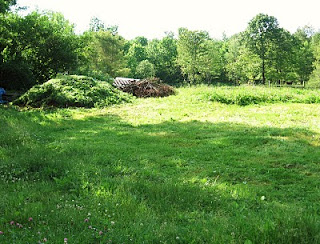 I hardly notice the reach. It is not an awkward extension but rather a subtle adjustment of eye and hand that has become, with practice, nearly automatic. (I'm still new at this, but I'm getting there.) If my arms begin to tire, I remind myself to use the rest of my body more, to let the scythe balance and skim along as I plant my foot and pivot my waist. The grass and clover fall in soft arcs before me. Looking back, I can see the cleared swath that is proud evidence of a working blade--all of this accomplished with barely a sound.
Around me, the birds have not faltered in their singing. The chirp of crickets goes on. I can hear our rooster proclaiming his place in the scheme of things, and the neighbor's sheep in their distant pasture offering a response. If a yellow admiral flutters by on bright wings, no hazardous, loud-motored machine keeps me from noticing and admiring it. Even the blade of my scythe tells me things about the world: the juiciness of grass stems, the playful sprawl of clover...and if a honeybee should land on a clover blossom near my blade, it is no trouble at all to turn and mow elsewhere until it has gathered its fill.
 Even with all these things to admire, the work gets done. There is a slight variance in the newly-mowed expanse--after all, I'm still learning and perfecting my techniques--but, while this yard may not make the cover of "Cosmopolitan Home," it makes us happy and proud. I feel good about my work, at home in my body, in love with this land. I need extract no oil nor pay any corporation to tend this beautiful green place.
Huzzah for the scythe!
There are options besides the "paralysis of analysis." You could reduce your own petrochemical use and collect spare hair or pantyhose for the cause. You could volunteer with the wildlife rescue teams or support locally-led reclamation programs in affected communities. If you happen to be an ArchDruid, you can guide people towards a more holistic understanding of the situation. Or, if you happen to be the Archbishop of Canterbury, you could bury your head in your mitre and obsess about something completely different.
We don't have hairdressers or pantyhose, and our budget for largesse is pretty much nonexistent, no matter the urgency of the cause. But there's one thing we can do: we can Just Say Mow.
We have a gasoline-powered lawn mower. It works well, though it's noisy to run and our uneven terrain causes the operator some unwelcome excitement with dips, bumps, scraped rocks and ejected debris. If a verdant expanse of precise and coordinated stem length was the central pride and joy of our lives, starting that machine up might be worth it. If we lived in a gated or planned suburban community, perhaps others might compel us to rev up the mower, citing terms of the Community Covenant.
But we don't live in a suburb. We live in Maine, the state where Katherine S. White wrote her great 1962 essay, "For the Recreation & Delight of the Inhabitants," on the bizarre, unnatural notion of "the lawn." Our sloping, rambling dooryard full of violets and clover may not, strictly, BE a lawn, but it is a rapidly-growing expanse that ought to be managed one way or another.
Our first thought was that the cows would take care of it.
 They do a decent job, though not a neat one, when we set up a temporary electric fence and turn them from their pasture into the yard, but there are some things they won't eat. They DO do a nice job, though, of fertilizing our "lawn," and the free-ranging chickens are good at distributing the fertilizer when they tear it apart in their quest for tasty grubs. When the cows are done, there is a mostly well-cropped expanse dotted with cowpats, lush tufts of unmunched grass, (where the cows peed), and tall, healthy weeds (which, for some reason known only to themselves, the cows occasionally refuse to eat).
So, what to do with the tufts--or with a whole yard--that must be mowed when the cows are engaged in their standard rotational grazing pastures? Time to requisition some equipment from our Luddite arsenal: get out the whetstone, the peening jig, and the scythe!
A scythe--how quaint. It triggers images of old-country peasants sweating in their masters' fields--poor unschooled bumpkins. Surely this tool could not be used today by those seeking improvement and innovation and a better way forward...or could it?
The fact is, a well-made scythe is a marvelous tool: beautifully crafted, exquisitely well-balanced, easy to heft, use, and maintain for decades. It requires no "inputs" other than the moderate strength and comfortable movement of the average human. How many gas-powered devices can make that set of claims?
The best thing about working with a scythe is the way it draws a person into active presence, opening rather than limiting one's ability to engage with nature. There is no engine's roar, whine, and sputter. There are no petrochemical fumes to urge one's movement away.
 There is just the feel of the smooth wood in your hands, the satisfying "snick" of the blade through damp grass, and the dance-like gentle movement of step-swing, step-swing. It is a simple and pleasant pursuit, particularly when accompanied by a friend with rake in hand, ready to gather and pile up the fresh cuttings for composting back into good, rich soil.
Unlike gas-powered mowers, scythes work best when the grass is wet: at daybreak and before, after, and even during a shower of rain. And so I rise in the morning, when the air is still full of birdsong and the dew is scattered like a hundred thousand jewels along the grass. I pull on my boots and my favorite work gloves, smiling at the now-faint "women's work" logo emblazoned on their backs. I take the scythe from its hook on the wall of the shed and the whetstone with its belt-clip holster. I add just enough water to the metal holster to keep the stone wet. I take a moment to admire the whetstone, another low-tech marvel. It is formed to fit two things precisely: the enfolding grasp of the human hand and the slope and curve of the scythe's long blade.
Once the stone is well-doused, I take it up and give a few ringing strokes along the blade. It's fun to make the blade sing, both of us tuning and warming up for a grand performance, preparing to step out onto the stage. When the blade is sharp, it is time to go. I survey the tall, grassy expanse around me. I swing the blade down and wrap my hands around the honey-coloured wood of the handles. I take my place at the edge, move into position, and begin the dance that is scything: step, reach-and-swing. Step, reach-and-swing. Step, reach and swing.
 I hardly notice the reach. It is not an awkward extension but rather a subtle adjustment of eye and hand that has become, with practice, nearly automatic. (I'm still new at this, but I'm getting there.) If my arms begin to tire, I remind myself to use the rest of my body more, to let the scythe balance and skim along as I plant my foot and pivot my waist. The grass and clover fall in soft arcs before me. Looking back, I can see the cleared swath that is proud evidence of a working blade--all of this accomplished with barely a sound.
 Around me, the birds have not faltered in their singing. The chirp of crickets goes on. I can hear our rooster proclaiming his place in the scheme of things, and the neighbor's sheep in their distant pasture offering a response. If a yellow admiral flutters by on bright wings, no hazardous, loud-motored machine keeps me from noticing and admiring it. Even the blade of my scythe tells me things about the world: the juiciness of grass stems, the playful sprawl of clover...and if a honeybee should land on a clover blossom near my blade, it is no trouble at all to turn and mow elsewhere until it has gathered its fill.
 Even with all these things to admire, the work gets done. There is a slight variance in the newly-mowed expanse--after all, I'm still learning and perfecting my techniques--but, while this yard may not make the cover of "Cosmopolitan Home," it makes us happy and proud. I feel good about my work, at home in my body, in love with this land. I need extract no oil nor pay any corporation to tend this beautiful green place.
 Huzzah for the scythe!
Friday, June 4, 2010
Barnyard Haiku II
This week at church, I presided over the first session of our "Soul Spa." (I loved the name so much I had to steal it. Thanks, Songbird!) It's a four-week program designed to encourage storytelling, fellowship, and creative exploration on spiritual themes among the women of the church. Each week has a hands-on no-skills-needed creative project, and our first one was a "ten-minute haiku" exercise in which we played with different names for God.
By the end of the session, we were all indulging in a fair amount of Holy Foolishness, and if anyone said anything that happened to be five or seven syllables long, someone would shout, "That works! That could be haiku!" The event exceeded my imaginings!
So, Dear Readers, I invite you to indulge in some further explorations. I've done a few of my own... can you comment with your own haiku related to God, Barnyards, Gardening, or any combination thereof? Profundities and Irreverence are both entirely welcome!
Here are mine:

The bees have come home.
Hurry, open, you flowers!
We make a welcome feast.

Open the new field.
Watch the cows leap, turn, and munch.
Such well-fed dancers!

Piglets at wood's edge
Snoozing under broadleaf trees:
No sunburned ears here.

Sweet, tender seedlings
Garden bed's green, lacy edge--
Get away, damn chickens!
By the end of the session, we were all indulging in a fair amount of Holy Foolishness, and if anyone said anything that happened to be five or seven syllables long, someone would shout, "That works! That could be haiku!" The event exceeded my imaginings!
So, Dear Readers, I invite you to indulge in some further explorations. I've done a few of my own... can you comment with your own haiku related to God, Barnyards, Gardening, or any combination thereof? Profundities and Irreverence are both entirely welcome!
Here are mine:

The bees have come home.
Hurry, open, you flowers!
We make a welcome feast.

Open the new field.
Watch the cows leap, turn, and munch.
Such well-fed dancers!

Piglets at wood's edge
Snoozing under broadleaf trees:
No sunburned ears here.

Sweet, tender seedlings
Garden bed's green, lacy edge--
Get away, damn chickens!
Wednesday, May 19, 2010
Explore-a-Spore!
Okay, enough with the preachy poetic stuff. Let's get back to the fun of raising, tending, preparing, and eating yummy earth-grown things! I have piglets to praise, bees to buzz about, and other farm projects to share. There's a wee Golden Comet pullet-chick snuggled into my shoulder, peeping quietly at me as I type. (She was brought into the house for a wee-wash-up of the sort chicks sometimes need. Once she's fully dry and warm, she'll go back to join the others under the heat-lamp in the barn.) This fuzzy, bustling, chirrupping little bird anchors me firmly in that multi-tasking yet fully-present and delighted state of being toward which all farmers strive.
In the midst of all this busy-ness, I'd like to introduce my favourite new blog: Midnight Cookies. The writing and kitchen wizardry are the result of a fruitful pairing: a Tir na nOg Wild Girl and her culinarily-gifted Sweetie! (Aye, this proud mama is utterly biased, but also fairly certain you'll enjoy our "borrowed daughter" and her blog as much as we do.)
The most recent "Midnight Cookies" post is inspired by mushrooms. So, it happens, are we. Here on the farm, we've been reading Paul Stamets' phenomenal book: "Mycelium Running: How Mushrooms Can Help Save the World." We got so excited we ordered several packages of mushroom spawn to start our own patches of gourmet mushrooms. It seems like a perfect solution to two of our ongoing land-management questions: what can we do with a perpetually boggy, shady area that defies all attempts at cultivation, and how shall we most profitably dispose of the non-native silver maples and weedy alders creeping into our woods? Maple and alder trees, it turns out, may be cut into logs and used to host several varieties of sought-after edible mushrooms. A wet area useless for fruit trees and berry bushes may be quite suitable for mushroom cultivation!
We'll let you know how it goes, but--contrary to popular opinion--mushrooms don't just spring up overnight. The mycelium must first be well-established. Our first harvest will likely come 9-12 months from now, when the patch has been carefully tended and conditions are right to initiate the first crop. After that, though, we may be able to enjoy several years of mushrooms from the same patch. It's a whole new learning curve, a whole new area of farming. We may be nuts, but we also intend to be well-fed!
In the midst of all this busy-ness, I'd like to introduce my favourite new blog: Midnight Cookies. The writing and kitchen wizardry are the result of a fruitful pairing: a Tir na nOg Wild Girl and her culinarily-gifted Sweetie! (Aye, this proud mama is utterly biased, but also fairly certain you'll enjoy our "borrowed daughter" and her blog as much as we do.)
The most recent "Midnight Cookies" post is inspired by mushrooms. So, it happens, are we. Here on the farm, we've been reading Paul Stamets' phenomenal book: "Mycelium Running: How Mushrooms Can Help Save the World."
 We got so excited we ordered several packages of mushroom spawn to start our own patches of gourmet mushrooms. It seems like a perfect solution to two of our ongoing land-management questions: what can we do with a perpetually boggy, shady area that defies all attempts at cultivation, and how shall we most profitably dispose of the non-native silver maples and weedy alders creeping into our woods? Maple and alder trees, it turns out, may be cut into logs and used to host several varieties of sought-after edible mushrooms. A wet area useless for fruit trees and berry bushes may be quite suitable for mushroom cultivation!
We'll let you know how it goes, but--contrary to popular opinion--mushrooms don't just spring up overnight. The mycelium must first be well-established. Our first harvest will likely come 9-12 months from now, when the patch has been carefully tended and conditions are right to initiate the first crop. After that, though, we may be able to enjoy several years of mushrooms from the same patch. It's a whole new learning curve, a whole new area of farming. We may be nuts, but we also intend to be well-fed!
Sunday, May 16, 2010
Purple Prose
(This is the sermon I preached last Sunday at my internship church. It explores the story of Lydia, a woman who helped create one of the earliest Christian churches. The sermon was based on two of the week's Common Lectionary readings: Acts 16:9-15 and John 14:23-27.)
FRINGE BENEFITS
I went and did it: I took one of those temporary jobs with the U.S. Census. I sat through four long days of training where the crew leader was required to lecture us, verbatim, from a massive textbook. We learned how to process all the necessary forms. We learned how to affix and protect our identity badges. But most importantly, we learned how to apply ourselves to the enormous task of counting everyone—not just the people who responsibly filled in and sent back their forms, but also the people who got busy and forgot, the people who accidentally threw them out, the people who had convinced themselves that one person more or less really didn't matter, in the big scheme of things.
As I started to travel up long dirt driveways, to grand, hidden houses, mobile homes, and even one abandoned shack, I thought a great deal about what it means to make people count—and to stand up and be counted. To the government, it means one set of things: balancing money for public programs, making sure each state gets the right number of congressional representatives. But what does it mean to a community of faith?
This week's reading from Acts introduces us to another woman who wondered: Lydia. Not Lydia the tattooed lady, but Lydia of Philippi, a purveyor of purple cloth.
Her purple cloth was beautiful-- some the colour of ripe grapes in sunlight, some the colour of the river just after the sun goes down. Sometimes a lot of cloth came out almost the colour of lapis, perfect to match the stones in a fine silver necklace or fancy finger-rings. Sometimes it was almost crimson, the colour of blood.
There were buyers waiting for all of it—courtiers seeking the blood-coloured cloth sought after by royalty, foreign buyers looking for cloth of rare quality and hue, wealthy men and women seeking a calculated splurge. Lydia counted on all these customers, for purple cloth was the ultimate status symbol, and the more deals she made, the more secure her own household might become. After all, in a colonial town, you had to make your own way. A woman couldn't count on authorities to protect her. The best course was to offer something the people in power wanted, and impress the people you needed to impress.
So Lydia learned all the details of her trade: how the sea-snails must be gathered by the tens of thousands to produce one garment's worth of dye, then heaped in vats to rot, the stench horrible beyond imagining. She learned the secret recipes and methods the dyers used: just how much sea-salt to add to the dye bath for the colour of priestly robes, and how to use two different types of snails—a double-dip in two stinking vats—to achieve the colour preferred by royalty. She learned how to keep track of accounts, who to flatter, and who to bribe. She learned which traders would give her a fair deal on fine cloth and the precious purple dye, worth its weight in silver.
Bit by bit, she made her way. She earned respect in the marketplace for her exquisite goods and she could walk freely there, a wealthy woman unchaperroned, proud, alone. She managed her business and her household with dignity and skill. Even her servants were elegantly clothed and well-fed.
But Lydia was still hungry. Something was missing, though she couldn't put her dye-stained finger on it. She found herself awake in the night, restless, anxious for no reason she could name. She was surrounded by beauty, but she had no peace. Her dreams, when they came, were full of broken shells and stinking dye vats. Though she had earned the freedom to stride through the marketplace, her spirit still felt trapped, shut up like coins in a box. And so, one day, she changed her usual route. She gathered her servants around her and headed down, past the temples and elite villas, past the glittering business of the marketplace, past the walled gardens and the city gates, all the way down to the river. She looked for a place to wash her stained hands, though she knew the stains were too old and deep for that. The other women stood and sat and kneeled at the water's edge, some of them washing clothes, some washing children or themselves. As they talked, they laughed—not the hard, cynical laughter of the marketplace, but a sound like the river itself: loose and musical and free.
They had gathered at the river to impress no-one. They were there not for trade, but for friendship, to listen to each other's stories and support each other with prayer—not prayers to the usual temple gods, but to another sort of God who seemed to care for people, actually cared for people instead of leaving them to their fate.
Something happened to Lydia, there. In the midst of her business, she began to carve out time for more visits to the river. She listened keenly to the other women's stories, her mind stirred by their different ways of life. She moved her mouth silently along with their prayers, unsure what to believe, trying out the feel of the words on her tongue.
And then, one day, some men meandered down the bank. The laughter and laundry and storytelling came to an abrupt halt. “Apostles” someone said. Apostles? What could they possibly be doing here, those hard-travelling holy men who ought to be headed for the synagogue? Lydia sized up the man called Paul with her shrewd merchant's eyes. His bearing was bold and confident. What was he doing outside the city gates? Why was he speaking to these women at the fringes? His accent betrayed a fine education and good breeding—clearly part of the fabric of society—yet he seemed to shine with untamable joy...
What happened then, the Book of Acts retells:
On the sabbath day we went outside the gate by the river, where we supposed there was a place of prayer; and we sat down and spoke to the women who had gathered there. A certain woman named Lydia, a worshiper of God, was listening to us; she was from the city of Thyatira and a dealer in purple cloth. The Lord opened her heart to listen eagerly to what was said by Paul.
When she and her household were baptized, she urged us, saying, "If you have judged me to be faithful to the Lord, come and stay at my home." And she prevailed upon us.
“Come and stay at my home.” It sounds so simple—almost childish. “Come and stay at my home.”--as if that means nothing more than sprucing up the guest room. But this is not the hospitality of vacation rentals and hotel chains. This is something deeper and more powerful. This is hospitality of a kind that can't be bought or sold like so much pretty cloth. Lydia opens her heart to the Holy Spirit, and her open house becomes a richly gifted Christian community—one of the first true “churches” of the New Testament. Lydia opens her heart to the Holy Spirit, and the people at the fringes are gathered into the center. Blossoms blow between the walled garden and the riverbank. The old rules of society are unthreaded and rewoven into a cloth more durable and colourful than before.
The Scholars don't quite know what to make of Lydia. Some say she was the first European Convert to Christianity and the Matron of the house church at Philippi. Others claim her name was merely shorthand for a whole group of women who helped found the earliest churches. The writer of the Book of Acts recalls her as a generous and influential leader. Later in the story, when Paul and Silas are suddenly freed from prison, Lydia's house is the loving and supportive community to which they run.
Scholars may still disagree on the particulars—after all, it is in their professional interest to do so—but Lydia still stands as a witness, holding open the door with her dye-stained hands. She stands to remind us what can happen when we look beyond our own circles, when we step beyond our own well-worn path. She beckons us to heed our spiritual hungers. She nudges us to venture to the fringes, to learn and listen and pray with those at the edge. Whether our hands are calloused or soft, manicured or stained, she calls us to reach out in welcome, daring to embrace the whole family of God.
Photo Sources: dye vats,
Gangites River at Philippi, Villa Fresco.
FRINGE BENEFITS
I went and did it: I took one of those temporary jobs with the U.S. Census. I sat through four long days of training where the crew leader was required to lecture us, verbatim, from a massive textbook. We learned how to process all the necessary forms. We learned how to affix and protect our identity badges. But most importantly, we learned how to apply ourselves to the enormous task of counting everyone—not just the people who responsibly filled in and sent back their forms, but also the people who got busy and forgot, the people who accidentally threw them out, the people who had convinced themselves that one person more or less really didn't matter, in the big scheme of things.
As I started to travel up long dirt driveways, to grand, hidden houses, mobile homes, and even one abandoned shack, I thought a great deal about what it means to make people count—and to stand up and be counted. To the government, it means one set of things: balancing money for public programs, making sure each state gets the right number of congressional representatives. But what does it mean to a community of faith?
This week's reading from Acts introduces us to another woman who wondered: Lydia. Not Lydia the tattooed lady, but Lydia of Philippi, a purveyor of purple cloth.
Her purple cloth was beautiful-- some the colour of ripe grapes in sunlight, some the colour of the river just after the sun goes down. Sometimes a lot of cloth came out almost the colour of lapis, perfect to match the stones in a fine silver necklace or fancy finger-rings. Sometimes it was almost crimson, the colour of blood.
There were buyers waiting for all of it—courtiers seeking the blood-coloured cloth sought after by royalty, foreign buyers looking for cloth of rare quality and hue, wealthy men and women seeking a calculated splurge.
 Lydia counted on all these customers, for purple cloth was the ultimate status symbol, and the more deals she made, the more secure her own household might become. After all, in a colonial town, you had to make your own way. A woman couldn't count on authorities to protect her. The best course was to offer something the people in power wanted, and impress the people you needed to impress.
So Lydia learned all the details of her trade: how the sea-snails must be gathered by the tens of thousands to produce one garment's worth of dye, then heaped in vats to rot, the stench horrible beyond imagining. She learned the secret recipes and methods the dyers used: just how much sea-salt to add to the dye bath for the colour of priestly robes, and how to use two different types of snails—a double-dip in two stinking vats—to achieve the colour preferred by royalty.
 She learned how to keep track of accounts, who to flatter, and who to bribe. She learned which traders would give her a fair deal on fine cloth and the precious purple dye, worth its weight in silver.
 Bit by bit, she made her way. She earned respect in the marketplace for her exquisite goods and she could walk freely there, a wealthy woman unchaperroned, proud, alone. She managed her business and her household with dignity and skill. Even her servants were elegantly clothed and well-fed.
But Lydia was still hungry. Something was missing, though she couldn't put her dye-stained finger on it. She found herself awake in the night, restless, anxious for no reason she could name. She was surrounded by beauty, but she had no peace. Her dreams, when they came, were full of broken shells and stinking dye vats. Though she had earned the freedom to stride through the marketplace, her spirit still felt trapped, shut up like coins in a box. And so, one day, she changed her usual route. She gathered her servants around her and headed down, past the temples and elite villas, past the glittering business of the marketplace, past the walled gardens and the city gates, all the way down to the river. She looked for a place to wash her stained hands, though she knew the stains were too old and deep for that. The other women stood and sat and kneeled at the water's edge, some of them washing clothes, some washing children or themselves. As they talked, they laughed—not the hard, cynical laughter of the marketplace, but a sound like the river itself: loose and musical and free.
They had gathered at the river to impress no-one.
 They were there not for trade, but for friendship, to listen to each other's stories and support each other with prayer—not prayers to the usual temple gods, but to another sort of God who seemed to care for people, actually cared for people instead of leaving them to their fate.
Something happened to Lydia, there. In the midst of her business, she began to carve out time for more visits to the river. She listened keenly to the other women's stories, her mind stirred by their different ways of life. She moved her mouth silently along with their prayers, unsure what to believe, trying out the feel of the words on her tongue.
And then, one day, some men meandered down the bank. The laughter and laundry and storytelling came to an abrupt halt. “Apostles” someone said. Apostles? What could they possibly be doing here, those hard-travelling holy men who ought to be headed for the synagogue? Lydia sized up the man called Paul with her shrewd merchant's eyes. His bearing was bold and confident. What was he doing outside the city gates? Why was he speaking to these women at the fringes? His accent betrayed a fine education and good breeding—clearly part of the fabric of society—yet he seemed to shine with untamable joy...
What happened then, the Book of Acts retells:
On the sabbath day we went outside the gate by the river, where we supposed there was a place of prayer; and we sat down and spoke to the women who had gathered there. A certain woman named Lydia, a worshiper of God, was listening to us; she was from the city of Thyatira and a dealer in purple cloth. The Lord opened her heart to listen eagerly to what was said by Paul.
When she and her household were baptized, she urged us, saying, "If you have judged me to be faithful to the Lord, come and stay at my home." And she prevailed upon us.
“Come and stay at my home.” It sounds so simple—almost childish. “Come and stay at my home.”--as if that means nothing more than sprucing up the guest room. But this is not the hospitality of vacation rentals and hotel chains. This is something deeper and more powerful. This is hospitality of a kind that can't be bought or sold like so much pretty cloth. Lydia opens her heart to the Holy Spirit, and her open house becomes a richly gifted Christian community—one of the first true “churches” of the New Testament. Lydia opens her heart to the Holy Spirit, and the people at the fringes are gathered into the center. Blossoms blow between the walled garden and the riverbank. The old rules of society are unthreaded and rewoven into a cloth more durable and colourful than before.
The Scholars don't quite know what to make of Lydia. Some say she was the first European Convert to Christianity and the Matron of the house church at Philippi. Others claim her name was merely shorthand for a whole group of women who helped found the earliest churches.
 The writer of the Book of Acts recalls her as a generous and influential leader. Later in the story, when Paul and Silas are suddenly freed from prison, Lydia's house is the loving and supportive community to which they run.
Scholars may still disagree on the particulars—after all, it is in their professional interest to do so—but Lydia still stands as a witness, holding open the door with her dye-stained hands. She stands to remind us what can happen when we look beyond our own circles, when we step beyond our own well-worn path. She beckons us to heed our spiritual hungers. She nudges us to venture to the fringes, to learn and listen and pray with those at the edge. Whether our hands are calloused or soft, manicured or stained, she calls us to reach out in welcome, daring to embrace the whole family of God.
Photo Sources: dye vats,

Gangites River at Philippi, Villa Fresco.


Wednesday, May 5, 2010
Lydia, Lydia, Have You Met Lydia...
In the midst of all those lovely Maytime tasks--piglet-tending, seedling-planting, power-washing the barn--I've dived into some additional adventures: a temporary census job and the ongoing challenges and opportunities of my ministry internship at a local U.C.C. church.
This coming Sunday, I'm supposed to lead worship and preach. The assigned lectionary readings include the story of Lydia. I've heard the old song about "Lydia the tattooed lady," but this biblical Lydia is a bit less "revealed." In fact, she is almost completely obscured by the purple cloth she purveys. We know very little about her, except that she appears to have been a successful business- woman who opened her home to some wandering apostles, whether they wanted to stay there or not. Some scholars suggest she was a devout follower of Judaism. Others say she was a foreign woman of questionable repute, possibly a Goddess-worshiper. Some say she didn't exist at all, but was merely written in as a symbol for the sort of people whose hospitality made the early house-churches possible. I wish I could know Lydia better... so I tried to imagine what her life was like in the Roman colony of Philippi, what brought her down to the river, what moved her to be baptized and then to ask those apostles, devout but dubious, into her home:
Acts 16: 13-15 (NRSV)
On the sabbath day we went outside the gate by the river, where we supposed there was a place of prayer; and we sat down and spoke to the women who had gathered there.
A certain woman named Lydia, a worshiper of God, was listening to us; she was from the city of Thyatira and a dealer in purple cloth. The Lord opened her heart to listen eagerly to what was said by Paul.
When she and her household were baptized, she urged us, saying, "If you have judged me to be faithful to the Lord, come and stay at my home." And she prevailed upon us.
Here's the Lydia I met in my mind's eye, crafted (so to speak) from whole (purple?) cloth:
LYDIA
The purple wouldn't wash off. Still,
Stubborn and savvy as ever, she planned her path
past market stalls, walled gardens, city gates
past the buzzing, glittering temple,
to a place outside: a praying place.
She went down to that dirty river and
prayed for the soft golden skin of her youth,
the bangles jangling on slender wrists,
the traceries of henna,
painted lines of prettiness and praise--
She prayed with hardened hands for better days.
She went down to that rough-edged river and
prayed for the soft smiles of all her servants,
so deft and deferent, so smooth and skilled
she could not quite learn whether she'd
earned—or merely bought—their trust--
She prayed with oil-rubbed skin and the taste of dust.
She went down to that deep old river and
prayed for the soft hollow of her soul,
the empty ache under the fine fabrics of her trade,
like a weeping burn, all bandage-bound.
She prayed at the river, where the women gathered.
She prayed at the river, where men seldom wandered.
She prayed at the river till a stranger prayed with her,
and the purple folds of her heart fell open
and the stains of her trade no longer concerned her
and she opened her house to apostles and pilgrims
there at the river,
there at the fringes,
where the Spirit weaves through
and the floods bring fertile ground.
--copyright MaineCelt 5/2010
Photo Source: The Global Spiral
This coming Sunday, I'm supposed to lead worship and preach. The assigned lectionary readings include the story of Lydia. I've heard the old song about "Lydia the tattooed lady," but this biblical Lydia is a bit less "revealed." In fact, she is almost completely obscured by the purple cloth she purveys.
 We know very little about her, except that she appears to have been a successful business- woman who opened her home to some wandering apostles, whether they wanted to stay there or not. Some scholars suggest she was a devout follower of Judaism. Others say she was a foreign woman of questionable repute, possibly a Goddess-worshiper. Some say she didn't exist at all, but was merely written in as a symbol for the sort of people whose hospitality made the early house-churches possible. I wish I could know Lydia better... so I tried to imagine what her life was like in the Roman colony of Philippi, what brought her down to the river, what moved her to be baptized and then to ask those apostles, devout but dubious, into her home:
 Acts 16: 13-15 (NRSV)
On the sabbath day we went outside the gate by the river, where we supposed there was a place of prayer; and we sat down and spoke to the women who had gathered there.
A certain woman named Lydia, a worshiper of God, was listening to us; she was from the city of Thyatira and a dealer in purple cloth. The Lord opened her heart to listen eagerly to what was said by Paul.
When she and her household were baptized, she urged us, saying, "If you have judged me to be faithful to the Lord, come and stay at my home." And she prevailed upon us.
Here's the Lydia I met in my mind's eye, crafted (so to speak) from whole (purple?) cloth:
LYDIA
The purple wouldn't wash off. Still,
Stubborn and savvy as ever, she planned her path
past market stalls, walled gardens, city gates
past the buzzing, glittering temple,
to a place outside: a praying place.
She went down to that dirty river and
prayed for the soft golden skin of her youth,
the bangles jangling on slender wrists,
the traceries of henna,
painted lines of prettiness and praise--
She prayed with hardened hands for better days.
She went down to that rough-edged river and
prayed for the soft smiles of all her servants,
so deft and deferent, so smooth and skilled
she could not quite learn whether she'd
earned—or merely bought—their trust--
She prayed with oil-rubbed skin and the taste of dust.
She went down to that deep old river and
prayed for the soft hollow of her soul,
the empty ache under the fine fabrics of her trade,
like a weeping burn, all bandage-bound.
She prayed at the river, where the women gathered.
She prayed at the river, where men seldom wandered.
She prayed at the river till a stranger prayed with her,
and the purple folds of her heart fell open
and the stains of her trade no longer concerned her
and she opened her house to apostles and pilgrims
there at the river,
there at the fringes,
where the Spirit weaves through
and the floods bring fertile ground.
--copyright MaineCelt 5/2010
Photo Source: The Global Spiral

Monday, April 12, 2010
Sprung?

SPRUNG?
O silver sky--
O scarlet-scattered maple
blossoming against
the slender bone-grey branch--
O wild greening gusting
wind-weft sky--
Not I.
O awkward egg--
O pipped, shell-chipping chicks
moist, fragile marvels
soon to shove, heave,
hop, peep, flap all feathery free--
Not me.
O in-rushing Spring--
O bird-bustling
bringer of singing
with pastures a-greening
Dashing the darkness,
splashing my toes with the dew--
How dare... oh!
How dear...
O, Darling!
Me too!

--copyright Mainecelt 4/2010
Subscribe to:
Posts (Atom)